
Desserts
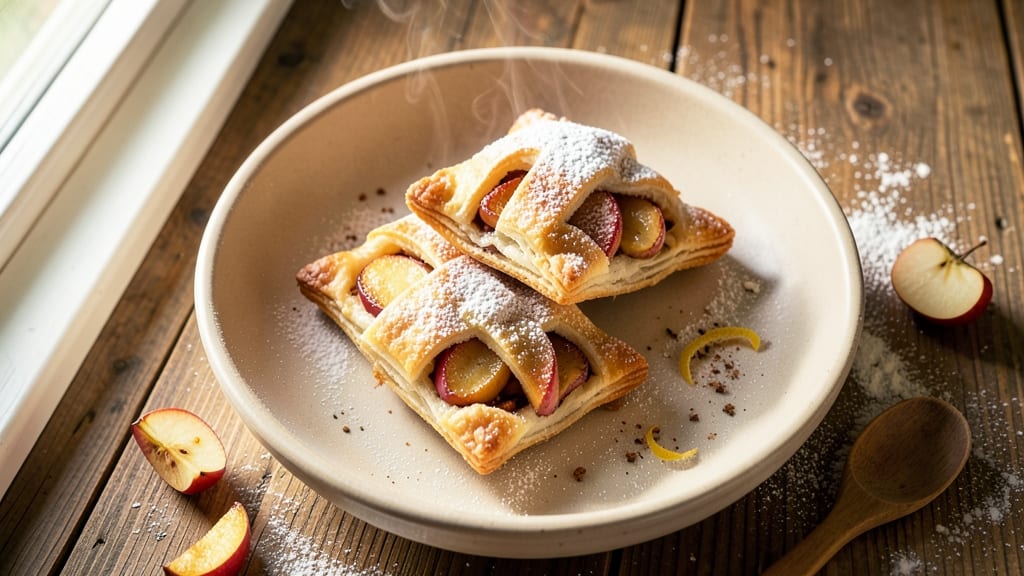
This Amish hand pie recipe delivers the comforting, flaky perfection of a classic country dessert with minimal fuss. The secret lies in a simple buttery crust folded into rustic half-moon shapes, enclosing sweet fruit fillings that bake up tender and golden.
I first tried this recipe during a Pennsylvania farm stay, where the warm, spiced aroma of baking pies filled the kitchen—and now it’s my go-to for potlucks or cozy afternoons.
The beauty of hand pies is their versatility: use classic apple or peach fillings, or try savory options like ham and cheese. The dough comes together with just a few ingredients—flour, lard, and a touch of salt—yielding a crisp, tender crust that holds up beautifully.
What sets these apart is the folding technique, where two circles of dough are pinched together to create those signature half-moon shapes.
By the time they emerge from the oven, you’ll have golden, flaky hand pies with a crisp edge and a soft, buttery center. The filling stays moist and flavorful, whether it’s spiced apples, berries, or even a savory twist.
These pies are perfect for picnics, holiday gatherings, or a simple dessert after a home-cooked meal.
No special equipment is needed—just a rolling pin and your hands. The recipe scales easily, so you can make a dozen for sharing or just a few for a quick treat. Let’s get started on these rustic, satisfying hand pies that taste like a slice of nostalgia.
Ingredients for amish hand pie
Twelve rustic hand pies with flaky crusts and spiced fruit filling—perfect for potlucks or cozy afternoons.
| Ingredient | Amount | Notes |
|---|---|---|
| All-Purpose Flour 🌾 | 4 cups | Sifted for light texture |
| Lard 🧈 | 1 cup | Cold, not melted |
| Granulated Sugar 🍚 | ½ cup | For crust sweetness |
| Salt 🧂 | 1 tsp | Fine sea salt preferred |
| Cold Water 💧 | ½ cup | Ice water for flakiness |
| Apples 🍎 | 4 medium | Peeled, cored, diced |
| Granulated Sugar 🍚 | ¾ cup | For filling sweetness |
| All-Purpose Flour 🌾 | ¼ cup | For filling thickness |
| Ground Cinnamon 🍃 | 1 tsp | Freshly ground preferred |
| Ground Nutmeg 🌿 | ¼ tsp | Freshly grated nutmeg |
| Lemon Juice 🍋 | 1 tbsp | Freshly squeezed |
| Unsalted Butter 🧈 | 2 tbsp | Melted for brushing |
| Granulated Sugar 🍚 | 1 tbsp | For egg wash |
The lard is non-negotiable for that signature Amish flakiness—Armour brand works best, but any leaf lard will do. King Arthur flour or Gold Medal gives the best texture, but don't stress if you've only got basic all-purpose. For the apples, Granny Smiths hold their shape best, but Honeycrisp or Braeburn work too. The key is peeling and dicing them evenly—no large chunks. If you can't find lard, crisco or vegetable shortening in a pinch, though the flavor won't be quite the same.
No cinnamon? Pumpkin pie spice at half the amount works in a bind. The nutmeg can be skipped if you're fresh out, but the lemon juice is essential—it keeps the filling from turning gray. For extra richness, add 1 tbsp of apple cider to the filling. The dough needs to be cold when you roll it out—chill it for 30 minutes if your kitchen's warm. And if you're making savory pies, swap the fruit for shredded cheddar and cooked ham, but keep the same crust recipe.
The dough keeps 3 days wrapped in plastic in the fridge, or 3 months frozen. The filled pies can be prepped ahead and baked fresh—just store them unbaked on a tray lined with parchment. Brush with melted butter and sprinkle sugar before baking for that classic golden crust. These reheat beautifully—350°F for 10 minutes restores all that flakiness. I always make a double batch and freeze half—perfect for last-minute company.
Why You'll Love This Recipe
- No-Fuss Dough: The crust comes together with just flour, lard, and cold water—no butter fussing, no rolling pins required. Honestly, I’ve made this while chatting on the phone; you just pat it into shape like a biscuit, and it’s ready to go.
- Sweet Crisp Magic: That sugar in the crust? It caramelizes just enough to give every bite a subtle buttery crunch. (Yes, even on a Tuesday night, when you’re craving something that feels like dessert but isn’t.)
- Pantry Staple Power: Flour, sugar, lard—you’re probably already stocked. I’ll be real: these pies cost me less than $2 for a whole batch, and they keep for days in the freezer. Perfect for when you’re low on cash or time.
Step-by-step instructions for Amish hand pies
Here's the method I use to create flaky, buttery crusts with a perfectly spiced apple filling.
Make the Crust Dough
In a large bowl, combine the 4 cups all-purpose flour and 1 tsp salt. Cut in the 1 cup cold lard using a pastry cutter or two forks until the mixture resembles coarse crumbs with pea-sized fat pieces. This texture is crucial for achieving that signature Amish flakiness.
Add the 0.5 cup granulated sugar and mix lightly with a fork. Gradually add the 0.5 cup cold water, 1 tablespoon at a time, mixing just until the dough comes together. Avoid overworking it—just combine until it forms a shaggy mass. Turn the dough onto a lightly floured surface and knead gently for about 30 seconds until smooth. Divide into two equal portions, flatten into discs, wrap in plastic, and refrigerate for at least 1 hour.
Prepare the Apple Filling
While the dough rests, peel, core, and dice the 4 medium apples into small, even pieces. In a large bowl, combine the diced apples with the 0.75 cup granulated sugar, 0.25 cup all-purpose flour, 1 tsp ground cinnamon, 0.25 tsp ground nutmeg, and 1 tbsp lemon juice. Mix gently but thoroughly to coat the apples evenly.
Place the filling mixture in a saucepan over medium heat and cook for 5-7 minutes, stirring occasionally, until the apples soften slightly but still retain their shape. Remove from heat and let cool completely before filling the pies. This step prevents a soggy crust when baking.
Roll and Cut the Dough
Preheat your oven to 375°F. On a lightly floured surface, roll one dough disc into a 12-inch circle about 1/8-inch thick. Use a 3-inch round cutter to cut out circles, then use a 1-inch circle cutter to cut out smaller circles from the center of each larger circle. This creates the classic hand pie shape.
Repeat with the second dough disc. You should have 12 large circles and 12 small circles. Keep the small circles separate—they'll be used to top the pies. Work quickly to keep the dough from warming up too much.
Assemble and Fill the Pies
Place 1 tablespoon of the cooled apple filling onto each large circle, leaving a 1-inch border around the edge. Fold the small circle in half to create a half-moon shape, then place it on top of the filling, pressing the edges gently to seal. Crimp the edges with a fork or your fingers to create a decorative pattern.
Place the assembled pies on a parchment-lined baking sheet, leaving 1 inch between each pie. Brush the tops with a mixture of 1 tbsp melted unsalted butter and 1 tbsp granulated sugar for a golden finish. Bake for 20-25 minutes until the crust is golden brown and the filling is bubbling.
Serve Warm
Remove the pies from the oven and let cool on the baking sheet for 5 minutes. The filling will thicken slightly as it cools, but the crust will remain tender. Serve warm for the best texture—each bite should deliver flaky, buttery layers with a perfectly spiced apple filling.
These hand pies are best enjoyed fresh, but they can be stored in an airtight container at room temperature for up to 2 days. For longer storage, freeze them before baking and reheat in a 350°F oven for 10-15 minutes.
Pro Tips For Making Amish Hand Pie
- Chill the Lard First: I learned this the hard way—trying to cut cold lard straight from the fridge into flour is like mixing butter with sand. Let it sit at room temperature for 10-15 minutes first, then cut it into the flour. The dough will handle better, and you’ll avoid greasy, crumbly messes that won’t hold together.
- Work Fast, But Don’t Rush: Amish hand pies need quick handling, but don’t treat this like a sprint. Once you mix the dough, work in 2-minute bursts, letting the dough rest between folds. Overworking it makes the crust tough, and underworking it leaves gaps. Think "goldilocks"—just enough to bring it together without stressing it.
- Skip the Pre-Baking: Your future self will thank you if you skip the pre-baking step. These pies are designed to bake fully in one go, and pre-baking dries out the crust before the filling even gets a chance to shine. Just fold, seal, and bake—no extra steps needed.
- Use a Bench Scraper for Sealing: The classic "pinch and fold" method works, but a bench scraper makes it foolproof. Press the scraper along the edge of the dough to create a clean, tight seal—no loose flaps, no filling leaks. It’s faster than fingers and gives you a professional-looking finish every time.
Regional styles of this recipe
Pennsylvania Dutch Roots
The Amish hand pie originated in the heart of the Pennsylvania Dutch communities, where resourcefulness and simplicity defined their baking traditions.
These pies were originally made with whatever fruit was in season—apples, peaches, or berries—and used lard instead of butter to keep costs low while achieving that signature flakiness.
The half-moon shape wasn’t just practical for easy handling; it also maximized oven space during large gatherings, like church potlucks or harvest celebrations. 🌾
In Lancaster County, where many Amish communities thrive, hand pies became a staple at fall festivals and holiday feasts. Families would gather in kitchens to make dozens at once, sharing the work and the warmth.
The lack of fancy tools—just flour, lard, and a rolling pin—made it accessible to everyone, reinforcing the Amish value of self-sufficiency. Today, these pies remain a symbol of that heritage, passed down through generations with only minor adaptations.
Ohio Amish Twists
While Pennsylvania is the birthplace of hand pies, the Ohio Amish put their own spin on the classic. Here, you’ll often find savory variations like ham and cheese or potato and onion fillings, reflecting the region’s German-Russian influences.
The crust might also include a pinch of black pepper or a splash of apple cider vinegar in the filling for extra tang. Ohio’s climate—with its shorter growing seasons—meant pies were frequently made with dried fruits or preserved berries during winter months. 🍎
Another Ohio tradition is the "open-face" hand pie, where the top crust is omitted entirely, allowing the filling to caramelize more deeply. This style is popular for peach or cherry pies, especially in rural areas where stone fruits were abundant.
The Ohio Amish also tend to use whole wheat flour in their crusts, adding a nuttier flavor and slight texture contrast to the buttery layers.
Midwest Farmhouse Adaptations
As Amish communities migrated westward, they adapted hand pies to local ingredients. In Iowa and Illinois, for example, rhubarb became a star filling, especially in spring when the tart vegetable was at its peak.
The Midwest’s cooler springs also led to the rise of custard-filled hand pies, where a simple egg mixture was folded into the fruit before baking. These were often served at county fairs or school fundraisers, where their portable size made them a hit. 🌟
Another Midwest innovation is the "double-crust" hand pie, where both the top and bottom are fully encased in dough. This style was particularly popular for sweet potato or pumpkin fillings, which benefited from the extra insulation to prevent sogginess.
Some families even added a thin layer of cornmeal between the crusts to create a crispy barrier, inspired by their corn-based diets.
Modern Homestyle Variations
Today’s home cooks are reimagining hand pies with global flavors while keeping the rustic spirit intact. Chocolate-hazelnut fillings (inspired by Nutella) or spiced pear and ginger combinations are now common in urban Amish bakeries.
Even sweet potato and maple pies—a nod to Vermont’s influence—have become a seasonal favorite. The key? Keeping the folding technique and buttery crust intact while experimenting with fillings. 🍫
For those short on time, pre-made pie crusts (like Pillsbury refrigerated dough) are a shortcut, though purists argue nothing beats the lard-based Amish crust.
Another modern twist? Mini hand pies—perfect for appetizers or kids’ parties—where the filling is reduced to 1 teaspoon per pie and baked in muffin tins for uniform sizes. These bite-sized versions are especially popular at weddings and brunch gatherings.
Nutrition facts
Frequently asked questions
Can I make savory Amish hand pies instead of sweet fruit versions?
The same buttery crust works perfectly for savory fillings. Try shredded cheddar with cooked ham, or caramelized onions with Gruyère. For extra flair, add a pinch of black pepper or a splash of apple cider vinegar to the filling. The key is to pre-cook any fillings (like meats or veggies) to avoid a soggy crust.
Why does my dough turn out tough instead of flaky?
Flakiness comes from keeping everything cold and handling the dough minimally. Overworking the dough or using warm lard destroys those delicate fat layers. Chill your dough for at least 1 hour before rolling, and don't press on it while cutting. If your kitchen's warm, freeze the dough for 20 minutes before shaping.
How do I store leftover hand pies?
Keep them fresh for 2 days at room temperature in an airtight container. For longer storage, freeze unbaked pies (on a tray first) for up to 3 months. To reheat, bake at 350°F for 10-15 minutes until crispy again. The crust reheats best when warmed through—microwaving makes it rubbery!
What's the best fruit for Amish hand pies?
Tart apples like Granny Smith hold their shape best, but peaches or rhubarb work beautifully too. For summer berries, toss them with a little cornstarch to thicken the juices. The filling should be slightly thickened before going into the crust to prevent leaks—cook it for 5-7 minutes until just tender.
Can I make these without a rolling pin?
Yes! For small batches, use a wine bottle or clean soda can to roll out the dough. Press firmly and roll in one direction. For larger batches, divide the dough into 4 portions and roll each between two sheets of parchment paper—this prevents sticking. The dough should be 1/8-inch thick for perfect flakiness.