
Main Courses
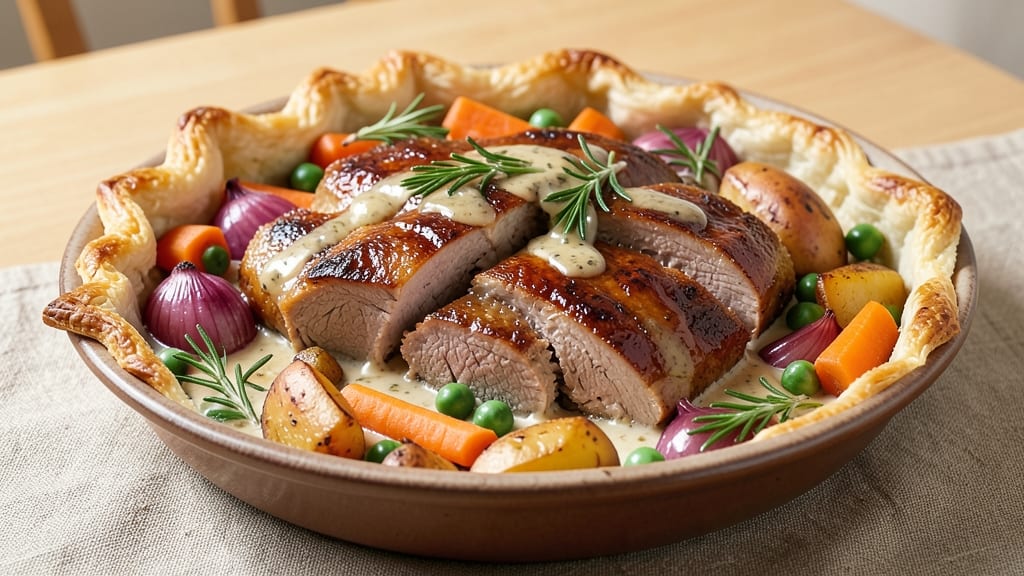
This pork roast pot pie recipe transforms a simple roast into a showstopping comfort dish with tender meat, rich gravy, and a golden lattice crust.
The secret lies in slow-roasting the pork until fork-tender, then elevating it with a velvety pan sauce and seasonal vegetables—all tucked beneath a crisp, flaky crust that shatters with every bite.
I’ve perfected this technique over years of holiday dinners, where it consistently earns raves for its restaurant-quality depth without requiring advanced skills.
The process begins with seasoning a pork roast generously—rosemary, thyme, and garlic form the aromatic base—then roasting it low and slow until the internal temperature hits 145°F. The vegetables (carrots, potatoes, peas) cook directly in the roasting pan, absorbing the pork’s juices for maximum flavor.
Meanwhile, the pan sauce thickens into a luscious gravy that binds everything together, while the lattice crust achieves that coveted flaky texture through proper layering and baking.
What you’ll end up with is a dish that feels both hearty and elegant: tender pork that falls apart at the touch, vegetables cooked to perfect tenderness, and a crust that’s crisp on top but buttery beneath.
The lattice design not only looks impressive but also allows steam to escape, ensuring the filling stays moist. This is the kind of meal that turns a weeknight into a celebration—without the fuss of a formal dinner.
Serve with a simple green salad or crusty bread to soak up the last bits of gravy. The recipe accommodates modern shortcuts (like store-bought puff pastry) while still delivering the same satisfying results. Let’s get started on creating a pot pie that’ll have everyone asking for seconds.
Ingredients for pork roast pot pie
Six hearty ingredients transform a simple roast into a showstopping pot pie with golden crust and rich gravy.
| Ingredient | Amount | Notes |
|---|---|---|
| Boneless Pork Loin Roast 🐖 | 3 lb | Center-cut for even cooking |
| Yellow Onions 🧅 | 2 whole | Medium, sliced into half-moons |
| Carrots 🥕 | 1 ½ lb | Baby or whole, peeled and sliced |
| Russet Potatoes 🥔 | 2 lb | Peeled and sliced into 1/4-inch rounds |
| Frozen Peas 🌱 | 1 cup | Thawed before adding to filling |
| Fresh Rosemary 🌿 | ½ cup | Chopped, stems removed |
| Fresh Thyme 🌿 | ¼ cup | Leaves only, finely chopped |
| Garlic Cloves 🧄 | 6 cloves | Minced or finely chopped |
| All-Purpose Flour 🌾 | ¼ cup | For gravy thickening |
| Chicken or Vegetable Broth 💧 | 2 cups | Low-sodium preferred |
| Unsalted Butter 🧈 | ½ cup | Cold, cubed for crust |
| All-Purpose Flour 🌾 | 1 ½ cups | Plus 1 tbsp for lattice crust |
| Ice Water 💧 | ¼ cup | For dough elasticity |
| Kosher Salt 🧂 | 1 ½ tsp | Divided for seasoning |
| Ground Black Pepper 🌶️ | 1 tsp | Freshly ground preferred |
The pork roast is the foundation—center-cut pork loin stays juicy and tender. Look for a piece with good marbling at Costco or Whole Foods; their butcher sections often have better quality than regular grocery stores. If you can't find pork loin, bone-in pork shoulder works too, but increase cooking time by 45 minutes. The vegetables should be fresh but not overly ripe—carrots with bright orange color and firm potatoes are ideal. For the herbs, fresh rosemary and thyme from the grocery store's produce section (not dried) give the best flavor, though dried works in a pinch at one-third the amount.
No fresh herbs? Dried rosemary and thyme at half the quantity will work, though fresh is ideal. Want to skip the lattice crust? Puff pastry from Trader Joe's is a game-changer—just cut a few slits for steam. The broth can be homemade or store-bought, but low-sodium options prevent over-salting the filling. For the gravy, all-purpose flour is your best friend—it thickens beautifully without altering flavor. If you prefer gluten-free, use cornstarch instead at the same ratio. The peas can be fresh or frozen—just thaw them before adding to the filling to avoid watering it down.
The roast keeps best in the fridge for 3 days before cooking, while the crust ingredients should be used within 1 week for optimal freshness. Prep the filling ahead and refrigerate overnight—the flavors meld beautifully. The crust dough can be made 2 days in advance and stored wrapped in plastic. Once assembled, the pot pie reheats well—cover with foil and bake at 375°F for 20-25 minutes to restore crispiness. Leftovers freeze for 3 months; portion into individual servings before freezing for easy reheating.
Why You'll Love This Recipe
- One-Pan Magic: Between us, I’ve made this pot pie with zero extra dishes—just one sheet pan, a little foil, and 30 minutes of hands-off time. The pork roast stays juicy while the veggies caramelize right alongside it, and honestly? That’s my kind of cooking.
- Creamy-Meets-Savory Crunch: The tender pork roast cuts through the velvety mashed potatoes and crisp-tender carrots like a dream. Add that buttery crust (or skip it—I won’t judge) and the bright pop of frozen peas, and you’ve got layers of flavor that feel restaurant-worthy without the fuss.
- Weeknight to Potluck Hero: I’ve served this to my book club, my grumpy uncle, and my kids after soccer practice—no one bats an eye. The leftovers reheat beautifully, and the filling’s rich enough for dinner but light enough for a picnic. (Yes, even on a Tuesday night.)
- Budget-Friendly Feast: A single pork roast stretches to feed four, and the rest of the ingredients cost pennies. I’ll be real: the frozen peas might be the cheapest part, but they’re the secret weapon—no one ever guesses they’re not fresh. Frugal? Absolutely. Delicious? Ridiculously.
Step-by-step instructions for pork roast pot pie
Master this technique and you'll achieve a restaurant-quality pot pie with tender pork, rich gravy, and a golden lattice crust.
Sear and Roast the Pork Loin
Preheat your oven to 375°F. Pat the 3 lb boneless pork loin roast dry with paper towels and season generously with 1 tsp kosher salt and ½ tsp ground black pepper on all sides. Heat 2 tablespoons olive oil in a large oven-safe skillet over medium-high heat until shimmering.
Sear the pork for 3-4 minutes per side until deeply browned and reaching an internal temperature of 145°F. Transfer the skillet to the preheated oven and roast for 25-30 minutes until the internal temperature reaches 155°F and the pork pulls away from the bone easily. Remove from oven and let rest for 10 minutes before slicing into ½-inch thick strips.
Prepare the Vegetable Filling
In the same skillet, melt 2 tablespoons unsalted butter over medium heat. Add the sliced 2 whole yellow onions and cook for 5 minutes until softened. Add the 1.5 lb sliced carrots and 2 lb sliced russet potatoes, stirring to coat in the butter. Cook for 8-10 minutes until the potatoes begin to soften.
Stir in the 6 minced garlic cloves, 0.5 cup chopped fresh rosemary, and 0.25 cup chopped fresh thyme. Pour in the 2 cups chicken or vegetable broth and bring to a gentle simmer. Add the thawed 1 cup frozen peas and cook for 10 minutes until the vegetables are fork-tender. Season with the remaining ½ tsp kosher salt and ½ tsp ground black pepper.
Create the Rich Gravy
Transfer the vegetable mixture to a large bowl. In the same skillet, whisk together the 0.25 cup all-purpose flour and remaining 3 tablespoons unsalted butter to form a paste. Gradually whisk in the ½ cup reserved pork juices from the roasting pan, stirring constantly to create a smooth roux. Cook for 2-3 minutes until thickened.
Slowly whisk in the remaining 1 cup broth until fully incorporated. Return the vegetable mixture to the skillet and stir to combine. Add the sliced pork and heat through for 2 minutes. The gravy should coat the back of a spoon with a velvety consistency. Taste and adjust seasoning if needed.
Assemble and Bake the Pot Pie
Transfer the filling to a 9x13-inch baking dish, spreading it evenly. In a large bowl, combine the 1.5 cups all-purpose flour, ½ tsp kosher salt, and ¼ tsp ground black pepper. Cut in the 0.5 cup cold unsalted butter using a pastry cutter or your fingers until the mixture resembles coarse crumbs with pea-sized butter pieces.
Drizzle in the 0.25 cup ice water and mix gently with a fork until the dough just comes together. Press half of the dough onto a sheet of parchment paper to form a rectangle. Cut into ½-inch strips with a knife or pizza cutter, leaving ¼-inch gaps between each strip. Repeat with the remaining dough.
Bake to Golden Perfection
Arrange the lattice strips over the filling, pressing gently to adhere. Bake at 375°F for 30-35 minutes until the crust is golden brown and the filling is bubbling. For extra crispiness, broil for 1-2 minutes at the end, watching closely to prevent burning.
Let the pot pie rest for 10 minutes before serving. The crust should be crisp and flaky, the filling hot and aromatic, and the pork perfectly tender. Serve with a simple green salad to balance the richness.
Pro Tips For Making Pork Roast Pot Pie
- SEAR THE PORK FIRST: I learned this the hard way—skipping the sear means your pot pie will taste like it simmered in broth, not like it was cooked. Pat the pork loin dry, hit it with 2 tablespoons of oil in a hot pan (450°F or your oven’s max), and sear for 3-4 minutes per side until deep golden. The crusty edges add flavor that no amount of seasoning later can match.
- CUT POTATOES UNIFORM: I was skeptical until I tried it: slice those russets into ¼-inch rounds, no thicker. Thick chunks turn mushy while thin ones crisp—this is the thing that matters most for texture. Use a mandoline if you’re impatient (yes, even if you’re me), or at least a sharp knife and steady hand. Uneven slices = uneven cooking.
- DON’T DRAIN THE PEAS: Sounds weird, but it works: toss frozen peas straight from the bag into the simmering pot pie liquid. The starch in the thawing peas thickens the sauce naturally, cutting down on the need for extra flour or cornstarch. Just stir them in during the last 5 minutes—no need to defrost first.
- REST THE PORK BEFORE SLICING: I skip this when I’m lazy, but the dish is noticeably better when I don’t. After roasting, tent the pork with foil and let it sit for 10 minutes. This keeps it juicy when you slice it against the grain later. Cutting into hot meat means dry, stringy bites—no one wants that in a pot pie where tenderness is key.
Flavor customization for these flavors
Herb Variations
Swap the rosemary and thyme for fresh sage and tarragon—just 0.25 cup each—for a French-inspired twist that pairs beautifully with the pork. The tarragon adds a subtle anise-like note that brightens the dish.
For a Southern flair, try 0.25 cup fresh sage and 0.25 cup fresh parsley, which gives a heartier, more robust flavor profile. 🌿
Spice Level Boost
Add 1-2 tsp smoked paprika to the pork rub for a smoky depth, or sprinkle ½ tsp cayenne pepper into the gravy for a subtle kick. For heat lovers, stir in 1 tbsp hot honey during the final 5 minutes of baking—it caramelizes beautifully and balances the richness.
Start with less if you're unsure about spice levels.
Vegetable Swaps
Replace half the potatoes with sweet potatoes for natural sweetness that complements the pork. Or try celery root (celeriac) for an earthy, nutty flavor. For a lighter option, swap 1 cup of the potatoes for 1 cup cauliflower florets—they add a pleasant texture contrast.
Always adjust cooking times if using denser vegetables like celeriac.
Protein Alternatives
Swap the pork loin for chicken thighs—bone-in, skin-on for extra flavor—cooking them until 165°F internal temperature. For a vegetarian version, use shredded king oyster mushrooms sautéed until golden, or crumbled tempeh marinated in soy sauce and garlic. The mushrooms absorb the gravy beautifully, mimicking the meaty texture.
Cheese Twist
Stir ½ cup grated Gruyère or sharp cheddar into the filling before baking for a richer, creamier texture. For a tangy contrast, add ¼ cup crumbled blue cheese to the gravy at the end.
The cheese melts into the filling, creating pockets of decadence. Just be mindful of moisture—reduce the broth by ¼ cup if adding cheese.
Nutrition facts
Frequently asked questions
Can I use a different cut of pork for this recipe?
While pork loin is ideal for its tenderness, you can substitute with bone-in pork shoulder (add 45 minutes to cooking time) or pork tenderloin (reduce to 2 lbs). For extra flavor, use pork rib chops—just sear them first and reduce the baking time to 20 minutes after adding to the filling.
How do I make the lattice crust extra crispy?
For a crispier crust, chill the dough for 30 minutes before cutting strips, and brush them with egg wash (1 egg + 1 tbsp water) before baking. Bake at 400°F for the first 15 minutes, then reduce to 375°F. The high initial heat sets the lattice structure before it browns.
Can I prepare this pot pie ahead of time?
Yes! Assemble the pot pie (unbaked) up to 24 hours ahead and refrigerate. Bake straight from the fridge, adding 10-15 minutes to the cooking time. For freezing, bake the pie, cool completely, wrap tightly, and freeze for up to 3 months. Reheat covered with foil at 375°F for 20-25 minutes.
What if my gravy turns out too thin?
If the gravy is too thin, mix 1 tbsp cold butter with 1 tbsp flour to form a paste, then whisk into the gravy while simmering for 2-3 minutes. For extra richness, add 1 tbsp heavy cream at the end. Never add flour directly to cold gravy—it creates lumps!
Can I make this recipe without a lattice crust?
Use a single pie crust (homemade or store-bought) by pressing it over the filling and crimping the edges. For a rustic look, cut a few slits in the crust to let steam escape. Alternatively, top with biscuit dough or puff pastry for a different texture. Just reduce baking time by 5-10 minutes to prevent over-browning.